How it works
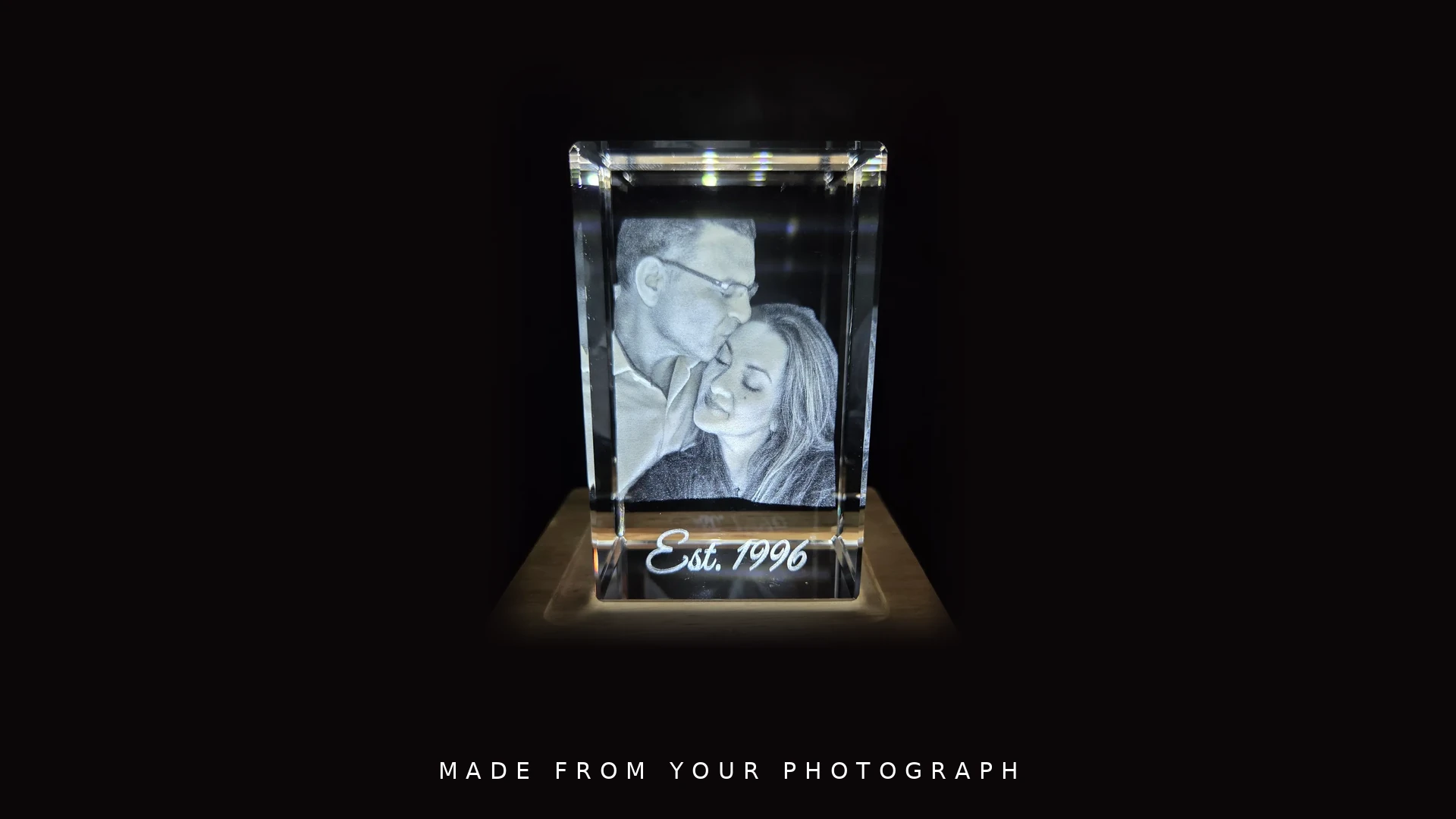
A photograph has no depth. We build it one, then engrave it inside the glass.
This is the whole process, including the parts most shops do not show you. It is worth reading if you are sending an old or difficult photograph.
- 01
The photograph you send
It does not need to be a professional picture. What matters is that the subject is sharp and lit from the front. We open every file and look at it before anything else happens.
If a photo will not engrave well we tell you before you have paid for anything to be cut, and suggest what to send instead.
- 02
We measure the depth
A flat photograph contains no depth information, so we reconstruct it: working out how far away each part of the subject is, and which parts are in front of which.
This is the step that decides whether the finished piece looks like a photograph suspended in glass or like a real object you could reach into.
- 03
It becomes a cloud of points
The depth map is turned into hundreds of thousands of individual points in three-dimensional space — a shape, not an image. You can see this in the video on our home page.
Bright parts of your photo become denser clusters of points; dark parts become sparser ones. That is what creates the shading.
- 04
The laser draws inside the glass
A focused beam passes through the surface of the crystal and only releases its energy at the point where it is aimed, leaving a fracture smaller than a grain of sand.
Repeat that several hundred thousand times and the fractures form your photograph, floating in the middle of a solid block.
- 05
You approve it first
You see the design before it is engraved. You can ask for a different crop, more or less contrast, or a different background.
Nothing is cut into the glass until you say yes.
- 06
Lit, boxed, posted
The finished crystal is checked under light, cleaned, and packed with its stand. Crystal is heavy and breakable, so it ships cushioned and boxed.
If it arrives damaged, we replace it.
Choosing a photograph
What engraves beautifully, and what does not.
Send these
- A clear face, or two to four people together
- A pet, sitting or standing, seen from the side or front
- A wedding or engagement photograph
- A portrait of someone who has died, even an old one
- A house, a car, a boat — anything with a recognisable outline
These will disappoint you
- Very dark photographs where the face is in shadow
- Motion blur, or a face smaller than a thumbnail in the frame
- Someone facing away, or hidden behind sunglasses and a hat
- Large groups where every single person must be recognisable
- Screenshots, heavily filtered images, or photos of photos
If the only photograph you have is a bad one, send it anyway. Old, faded and damaged pictures are exactly what we are good at — restoration is included, and we will tell you honestly what is achievable before you commit.
In daylight and in the dark
In ordinary daylight the engraving is subtle: a faint white image inside clear glass, easiest to see against a dark background. Put it on the lit stand and the whole picture lifts out of the crystal and becomes the thing everyone notices.
That is why the stand matters more than it sounds. The crystal is the keepsake; the light is what makes people pick it up.